My New Knock Around Guitar

IMG_0387IMG_0388IMG_0390

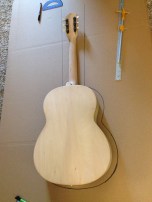
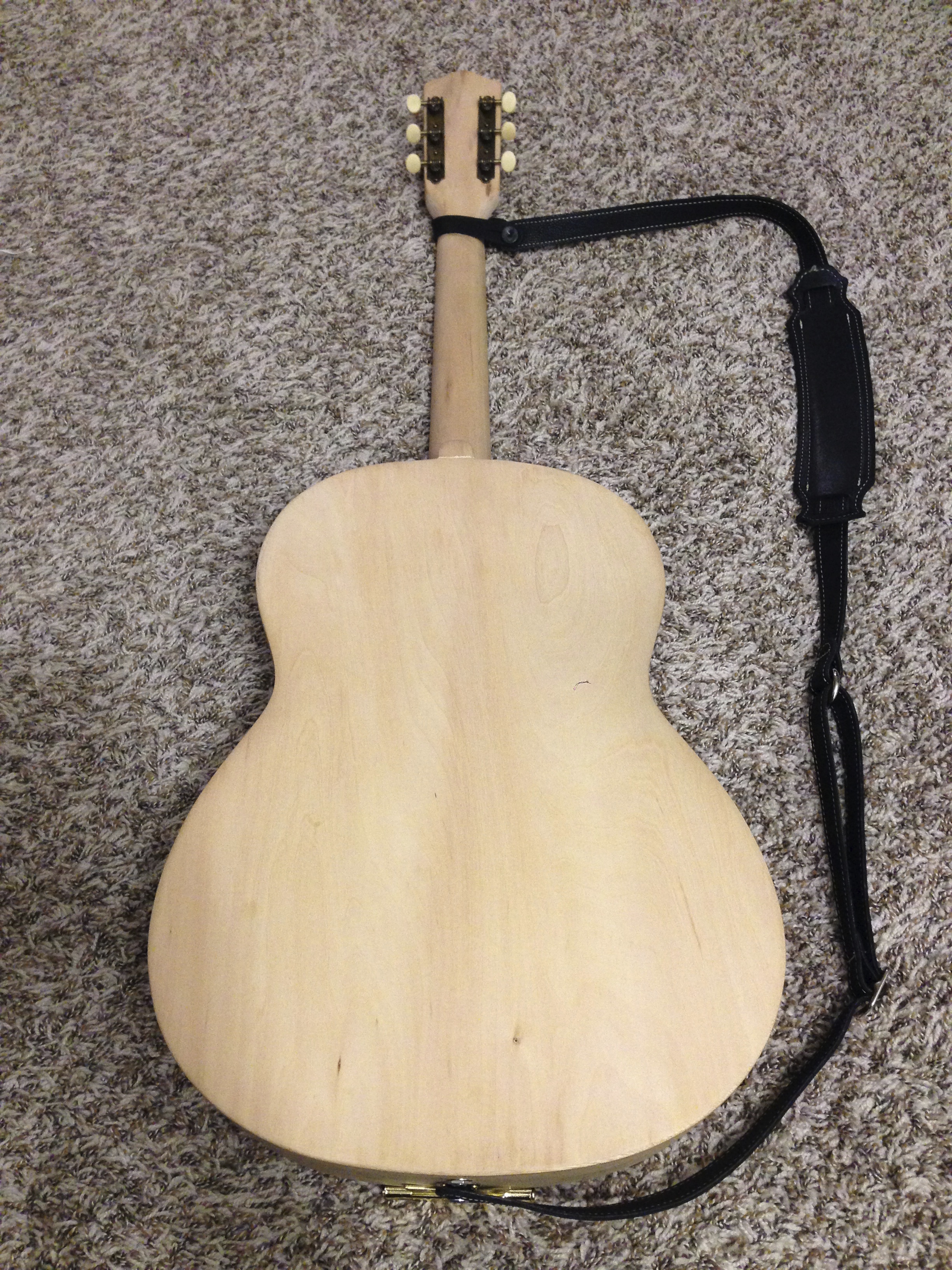
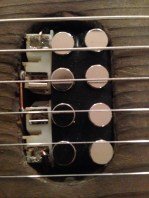
I picked this up for thirty bucks at the local antique mall. It’s a Jay G parlor guitar made in the U. S. by Jackson Guldan in the late fifties-early sixties. Some interesting features inherent to this guitar are the bolt-on neck and the simple mechanism used to set the action.

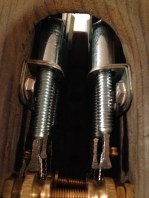
I bought this guitar with the action set like this, but check out the adjusting mechanism—it’s a piece of angle iron with one end bolted to the bottom of the neck and the other end fitted with an adjustment bolt. Simply turn the adjustment bolt one way or the other to set the action.

IMG_0384IMG_0382

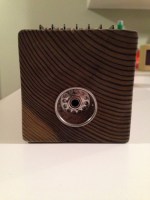
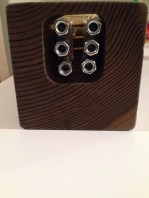
The neck is held on with one bolt through the back and it came standard with Kluson Deluxe closed-back tuners.

IMG_0386IMG_0391

Dig this low action.

IMG_0385

This guitar is solid; it weighs in at around four pounds and seems to be built to last. It is the perfect knock around guitar—one of those playing on the porch during a storm, strapped on your back while your grilling, tossed to the concrete, because your kid is falling out of the tree guitars…but we’ll see how it fairs.

Thanks,

img_1926-1

9 Volt Power Adapter Acoustic Guitar Pickup


IMG_0300IMG_0296IMG_0291

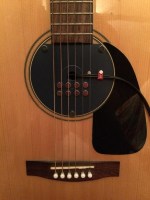
My newest creation—a removable acoustic guitar pickup/sound hole cover. I have wanted to make this pickup for years, ever since I first saw these instructions for making an acoustic guitar sound hole cover from a CD/DVD:

http://m.instructables.com/id/Make-a-CDDVD-Guitar-Sound-hole-Cover/?ALLSTEPS

The pickup sounds excellent, with very little noise/feedback, and is wired for stereo output.

Here is the design that the pickup is based upon:

https://junkshopaudio.com/9-volt-power-adapter-guitar-pickup/

Check out the video demonstration below—nothing too spectacular, just enough to let you hear how it works. 

Only this and the video for now, but I will post more images and some production notes soon.

Thanks,

img_1926


Resonator Guitar Project

IMG_0168IMG_0169IMG_0171IMG_0174

I released a short post outlining this project in November of last year. At that time, I thought it was complete; however, I had been unhappy with certain aspects of the build. Since then, I have created a bridge assembly that has fixed a variety of problems from rattling to strings slipping.

Check out the new bridge by clicking on the following link:

https://junkshopaudio.com/resonator-guitar-project/

Thanks,

img_1926-1

4×4 Electric Steel Slide Guitar

IMG_2896IMG_2935IMG_2889

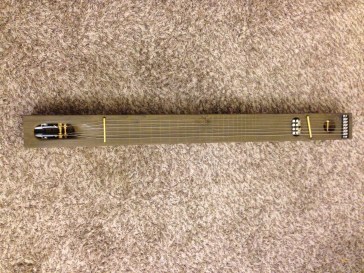
Last week I completed a new six-string steel guitar design. It was my intention to keep all of the components within the body of the 4×4 post, with just the strings flowing out of the body over the two brass bolts. The instrument has a really low top profile and the sides are fully intact to preserve the linear flow of the body.

IMG_2898IMG_2897

The pickup is constructed from two 9 volt power adapter coils and has a different look than previous designs, because they were extracted from a different brand of adapter. Follow this link to instructions for building pickups from 9 volt adapters: https://junkshopaudio.com/9-volt-power-adapter-guitar-pickup/

A 1/4″ audio jack was mounted in a 1-1/4 drain to lessen the profile of the jack and shorten the protrusion of the guitar cord from the end of the guitar.

IMG_2894IMG_2888

The tuners are based upon my design that I unveiled on the Baseball Bat Guitar that I featured last November.

.IMG_2849

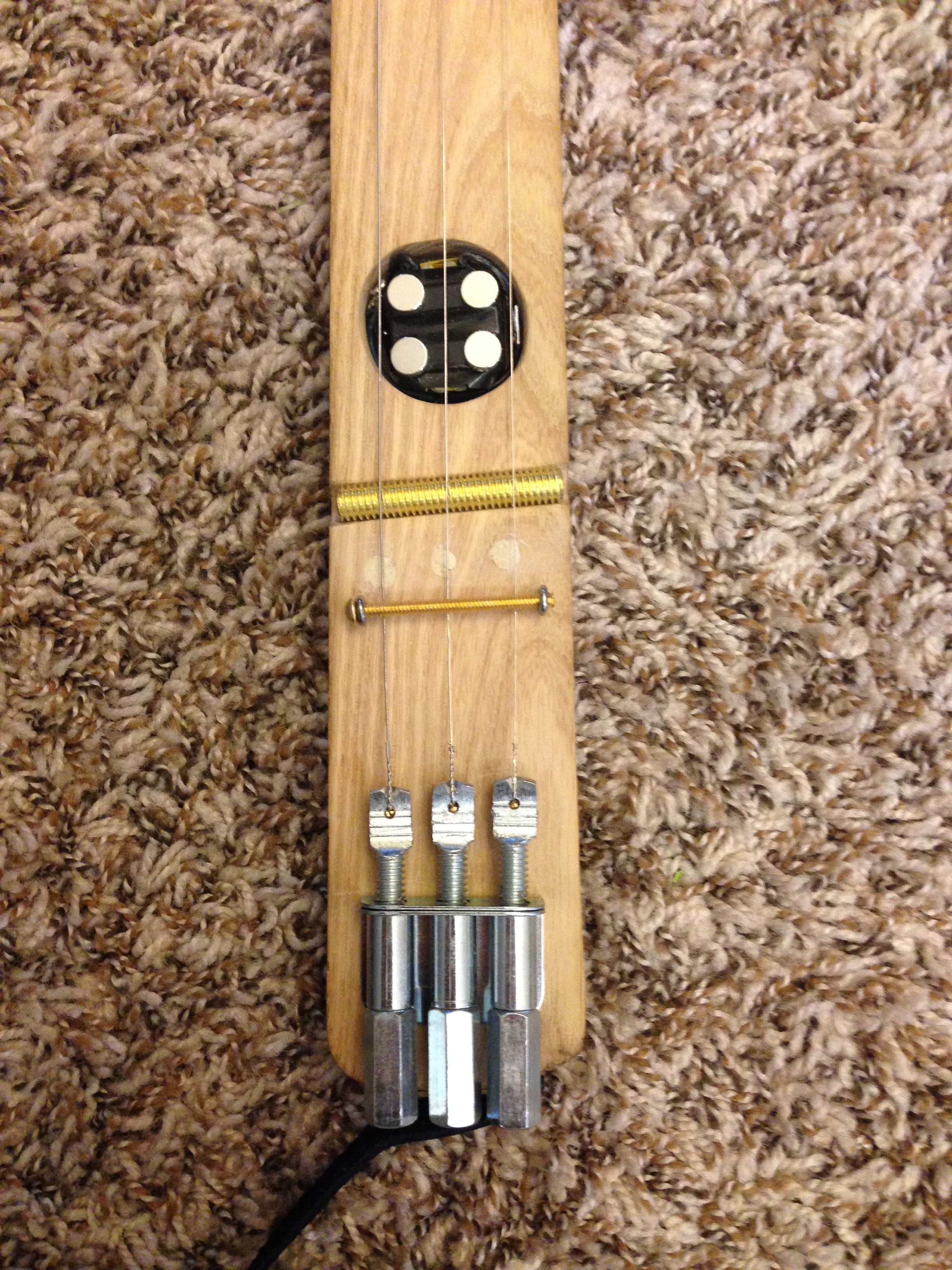
I used two sets of three tuners, similar to those used on the Baseball Bat Guitar, and installed them vertically within the body. The end of the guitar  was cut open so that a 3/8″ hex driver can be used to tune the strings. Brass studs and knurled nuts were used to keep the tuners straight and the body was carved to naturally guide the strings out over the nut to ensure proper spacing. If left in this state, the tuners would turn instead of tightening; therefore, I fabricated two small steel parts to hold the tuners in place, thus forcing the machines to tighten. They fit tightly, but slip off easily when the tuners are in an vertical position.

IMG_2893IMG_2890IMG_2886IMG_2938

Additionally, the frets are filed grooves, the strings are mounted on an electrical barrier strip, and the body was stained with a mixture of steel wool and vinegar that has been fermenting for about a year—it results in an awesome rustic/worn finish and can be lightly sanded to imitate wear.

This was a cool project. I learned a lot from the experience and will make only a few minor changes upon creating its successor.

IMG_1926

Baseball Bat “Cigar Box Style” Guitar

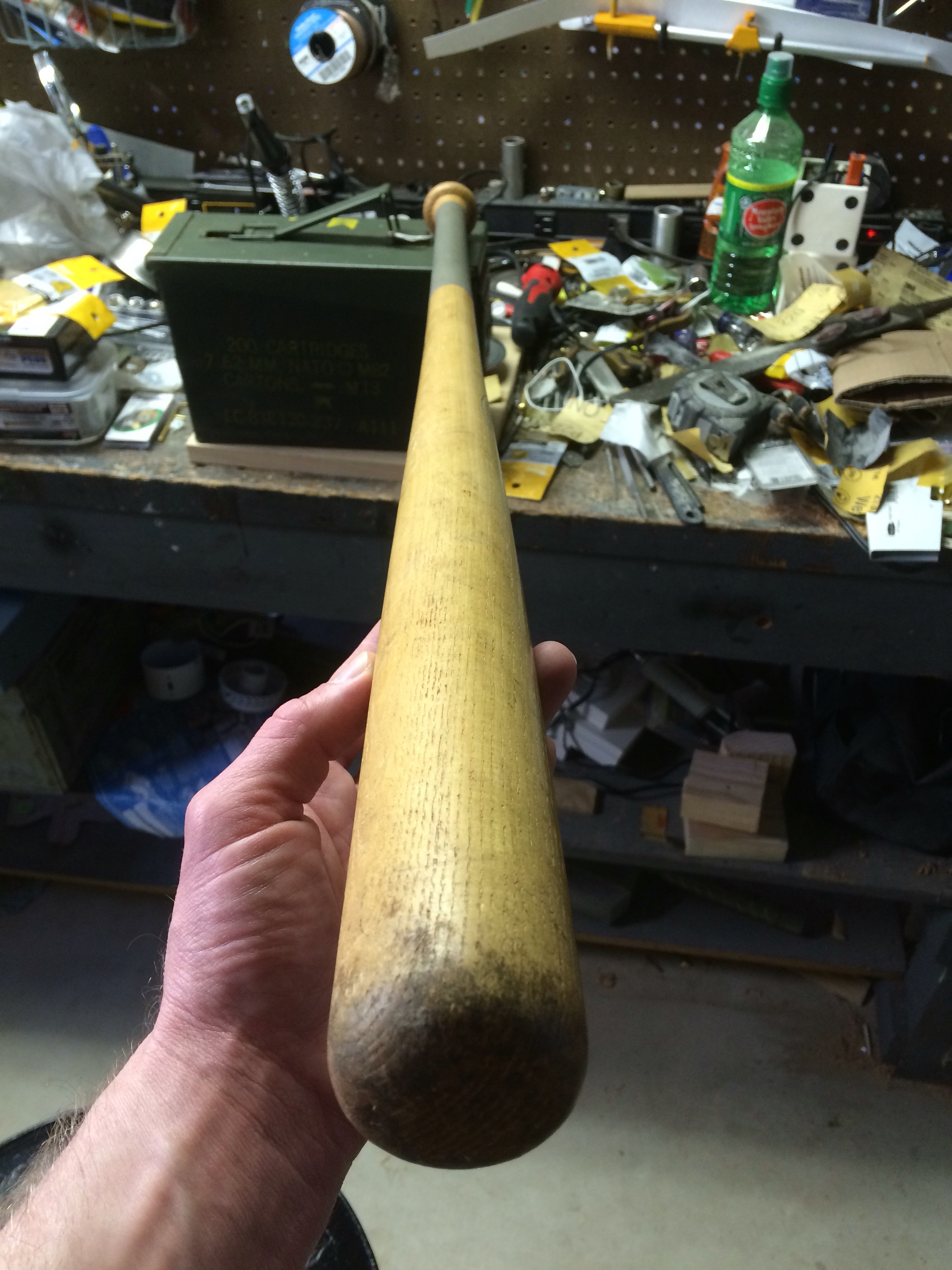
I just finished my baseball bat guitar prototype over the weekend. I learned a lot from making this one—the next one will be way cooler, with less broken screws and filled holes. Regardless, I’m really happy with the results.

It’s a three-string electric guitar, that holds its tune and is super durable. I left this one fretless, but I may install frets cut from brass rod on the next one.

Just pictures for now; I’ll follow up with some build pictures and perhaps some video down the line.

IMG_2851 IMG_2848 IMG_2849 IMG_2850

Thanks,

uW5Z0b

Duct Tape Case for Resonator Guitar

IMG_2703 IMG_2701 IMG_2705

After completing the resonator guitar project, I set out to find a case for it. It was difficult to find a reasonably priced guitar case, so I thought of making something distinctive out of wood. Then, I considered how duct tape could be used as a primary building material—this case is the product of that notion.

It took seven rolls of duct tape, one large 2-ply box, and a length of chain.

IMG_2649 IMG_2650 IMG_2651 IMG_2652

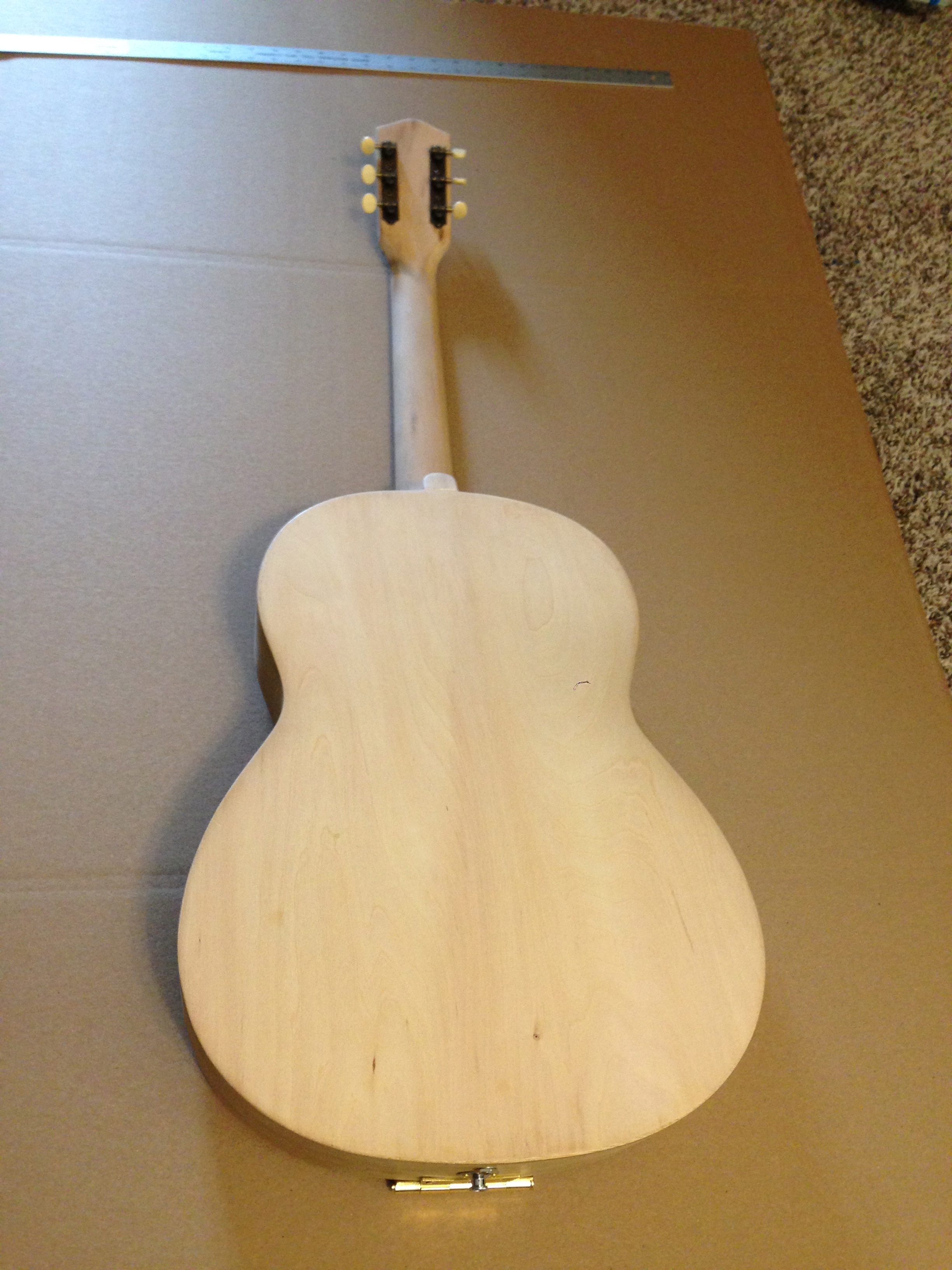
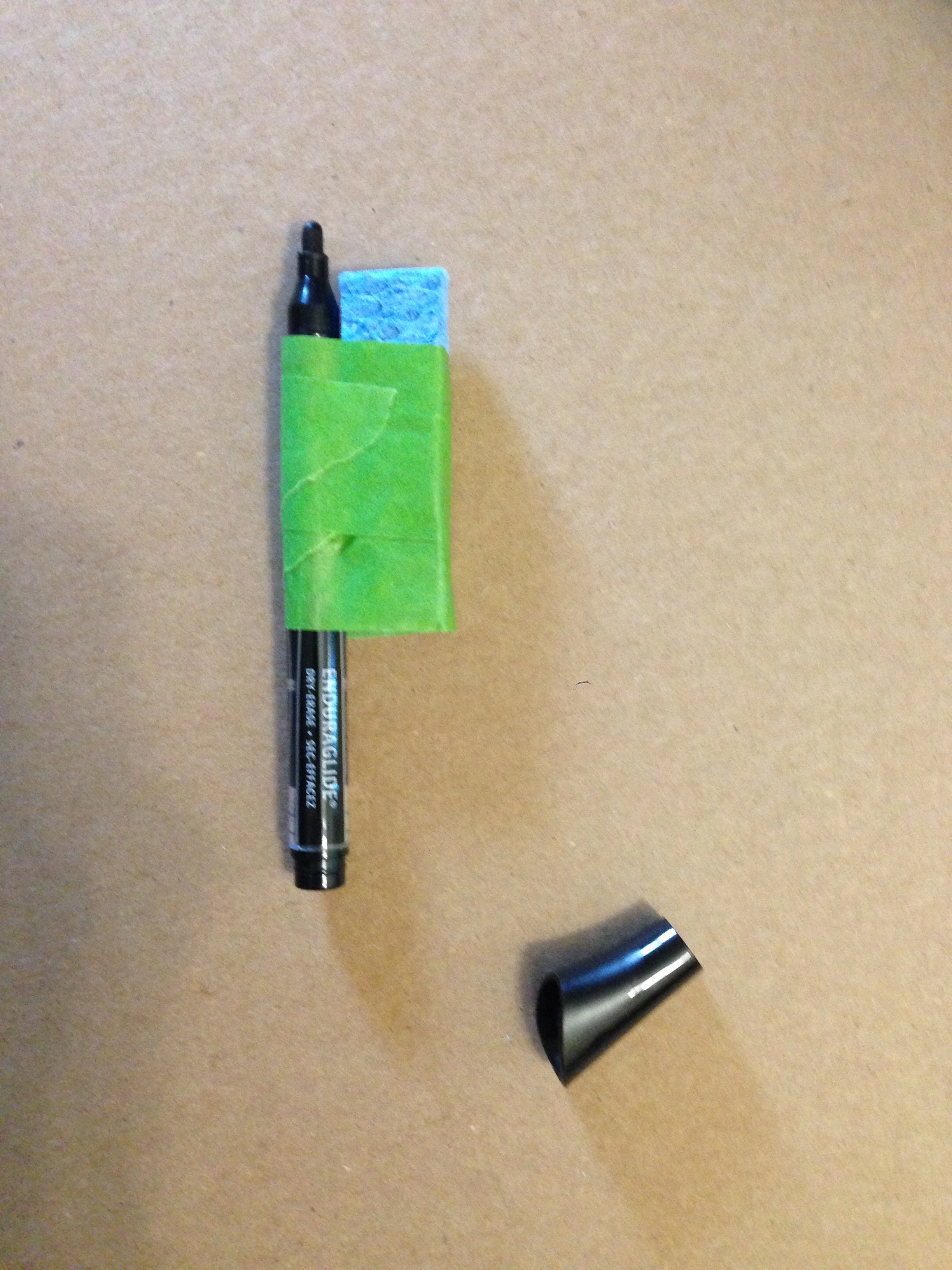
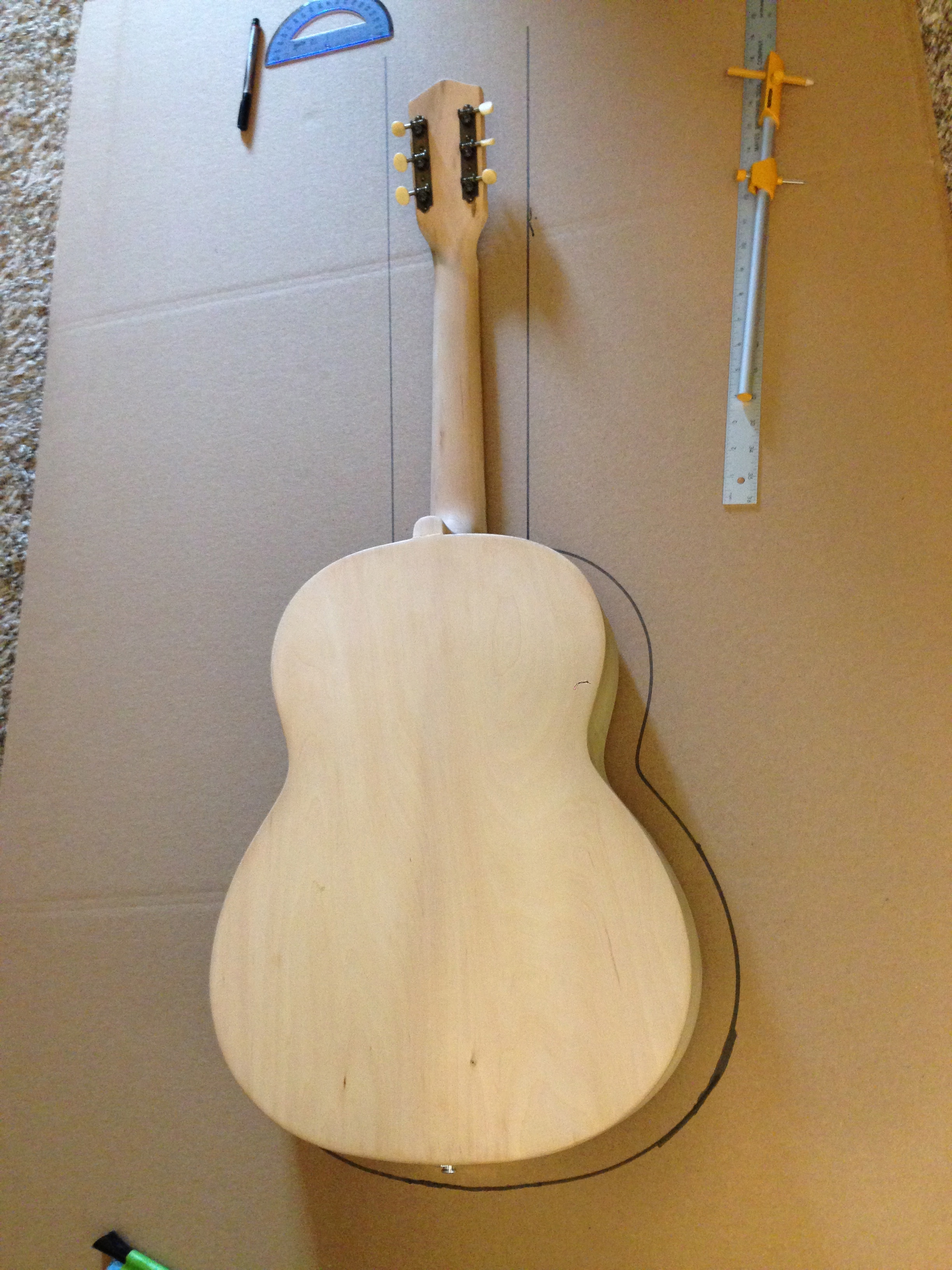
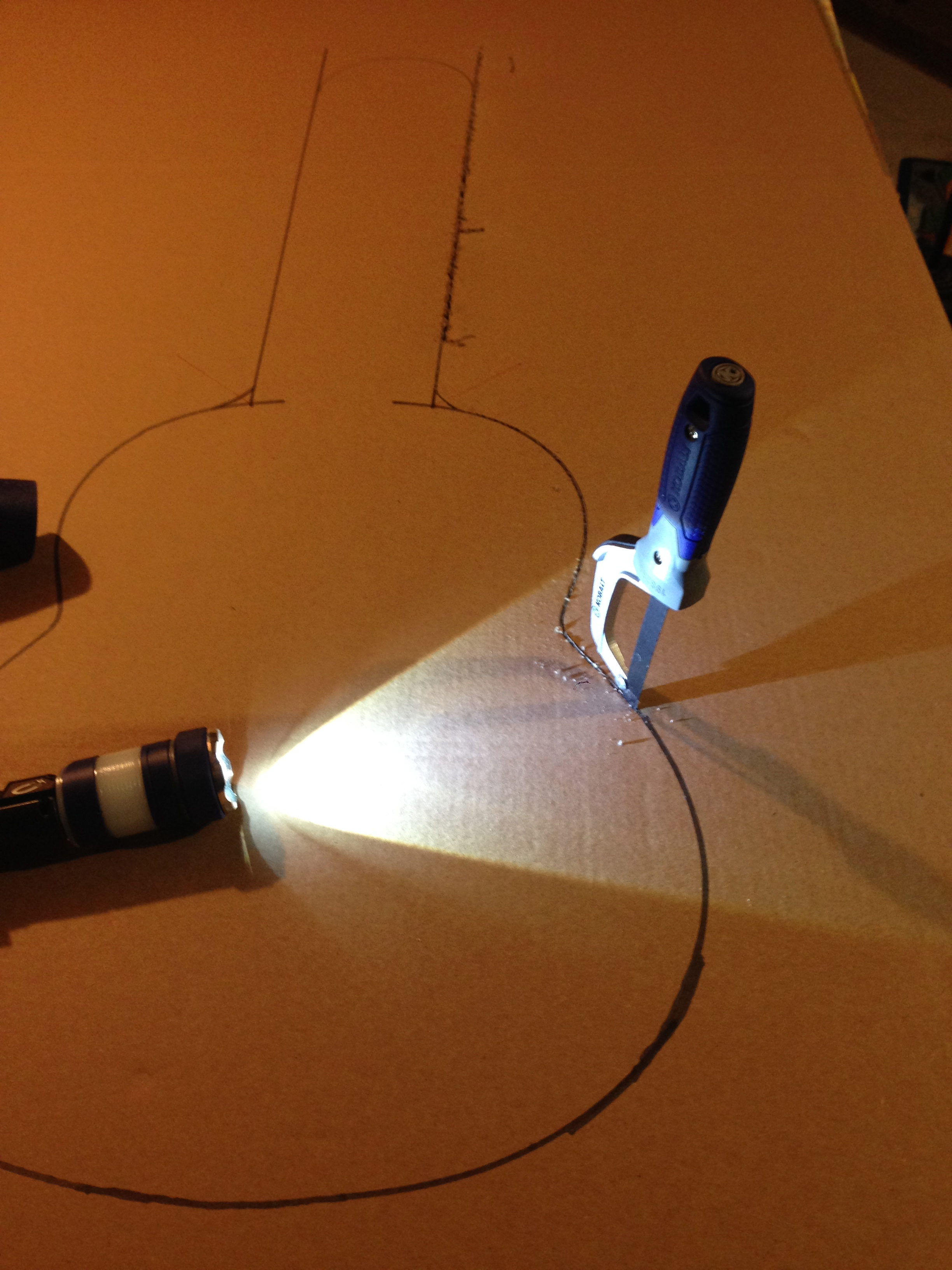
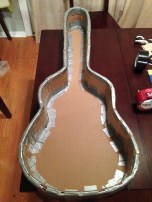
I began by tracing the guitar for a custom fit. I cut a thin sponge down to a 3/4” strip, and taped it to a marker to create about a 1” outline around the body of the guitar. Then I measured about an 1” on either side of the tuning machines and finished the neck portion of the case with a ruler and a compass to round off the top.

IMG_2653 IMG_2654 IMG_2655 IMG_2658

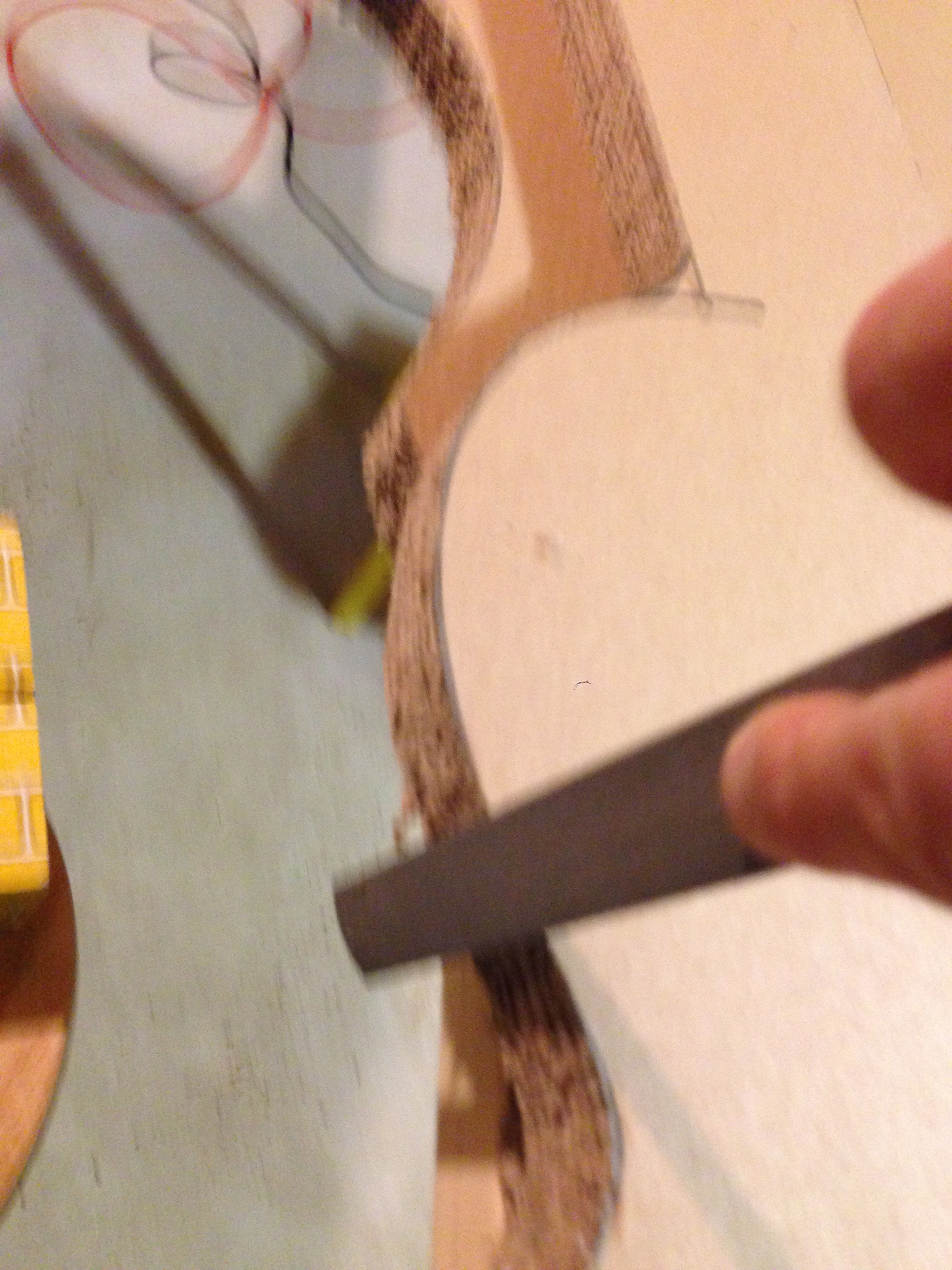
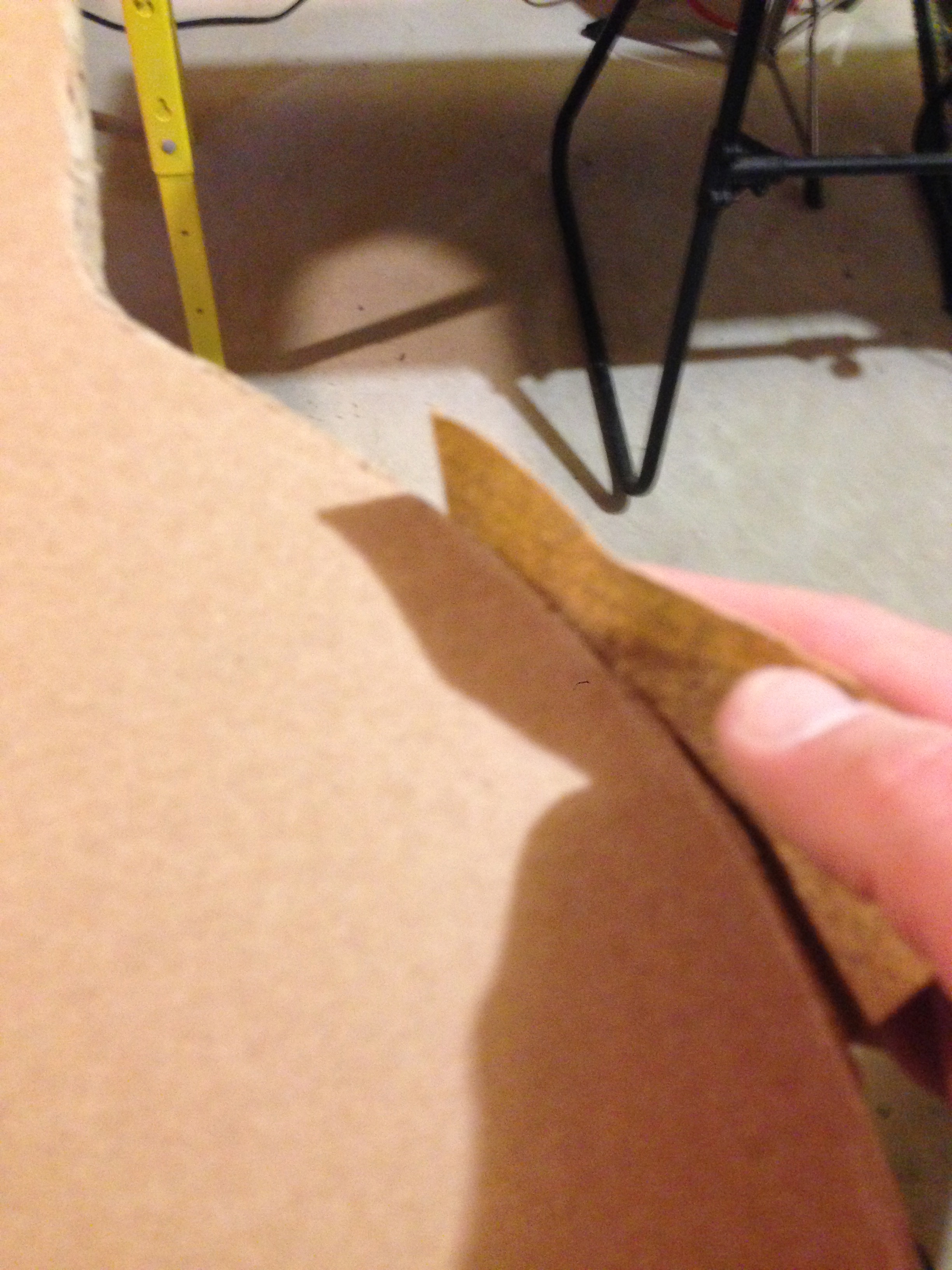
At this point, the box was folded in half creating an 8-ply thickness. I cut along the guide line with a mini hacksaw, which produced a pretty clean cut. Then, I filed the perimeter of the cutout, following up with some 150 grit sandpaper. I checked the cutout against the guitar and it appeared to fit well.

IMG_2660 IMG_2662IMG_2663

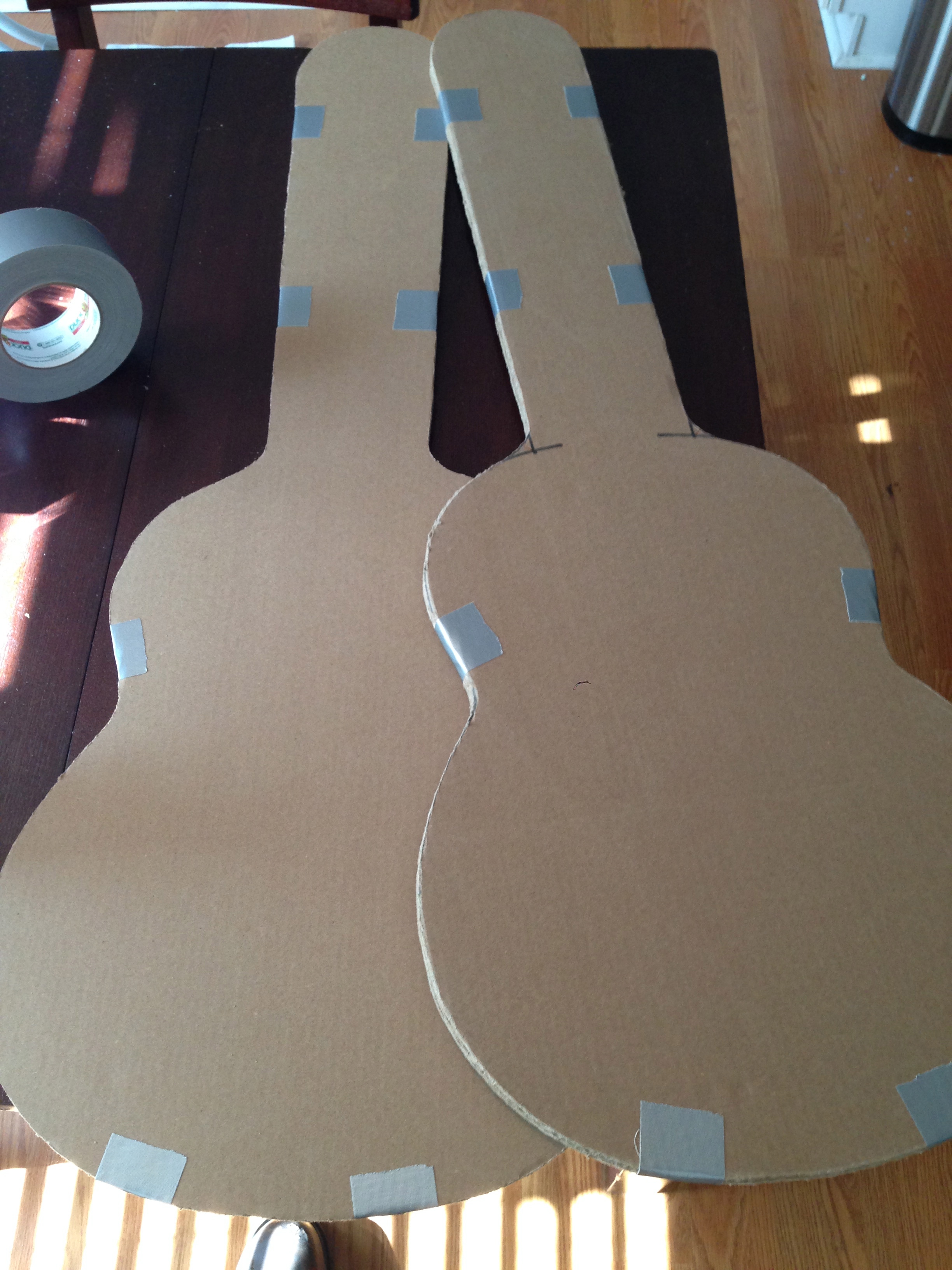
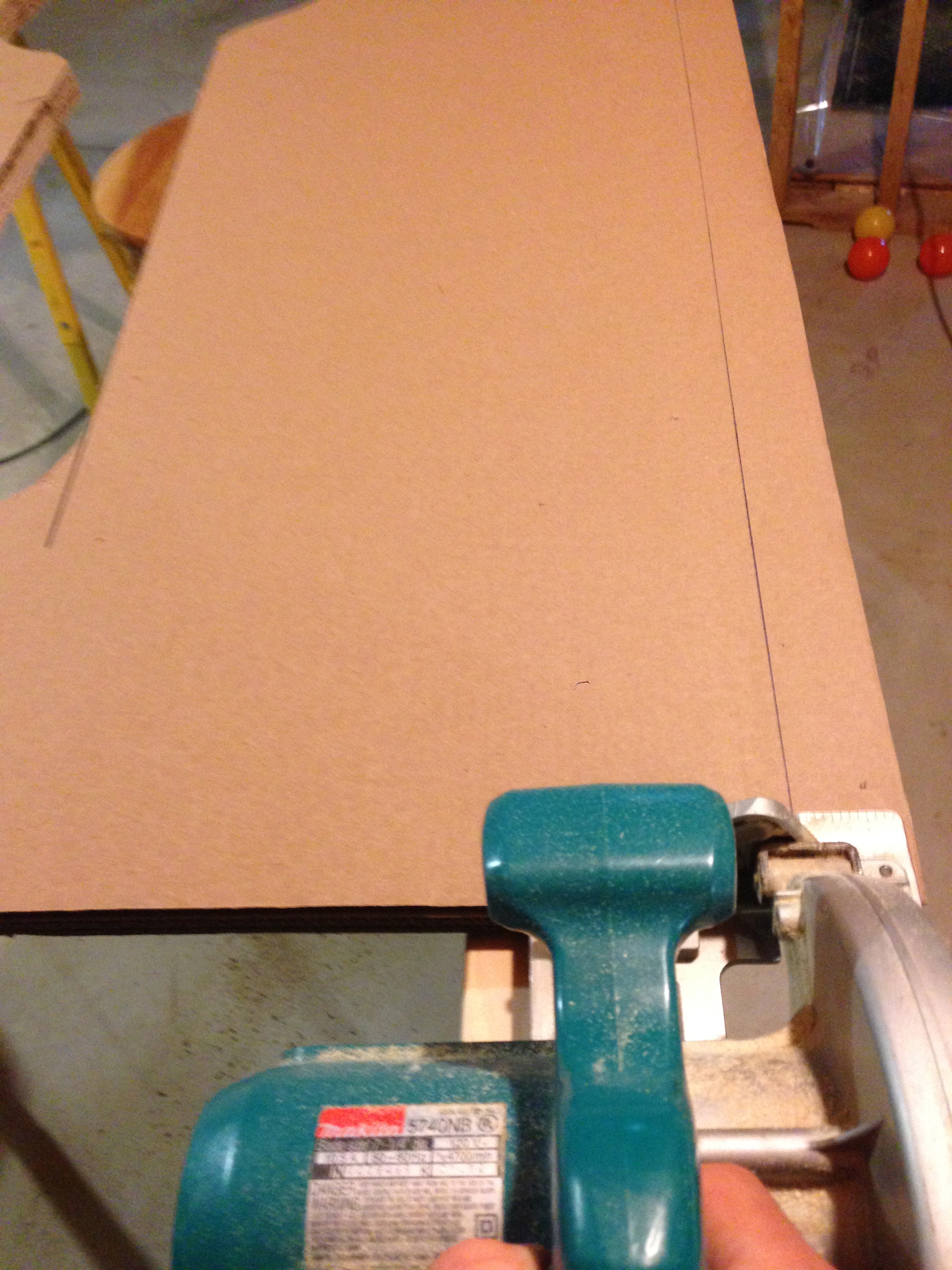
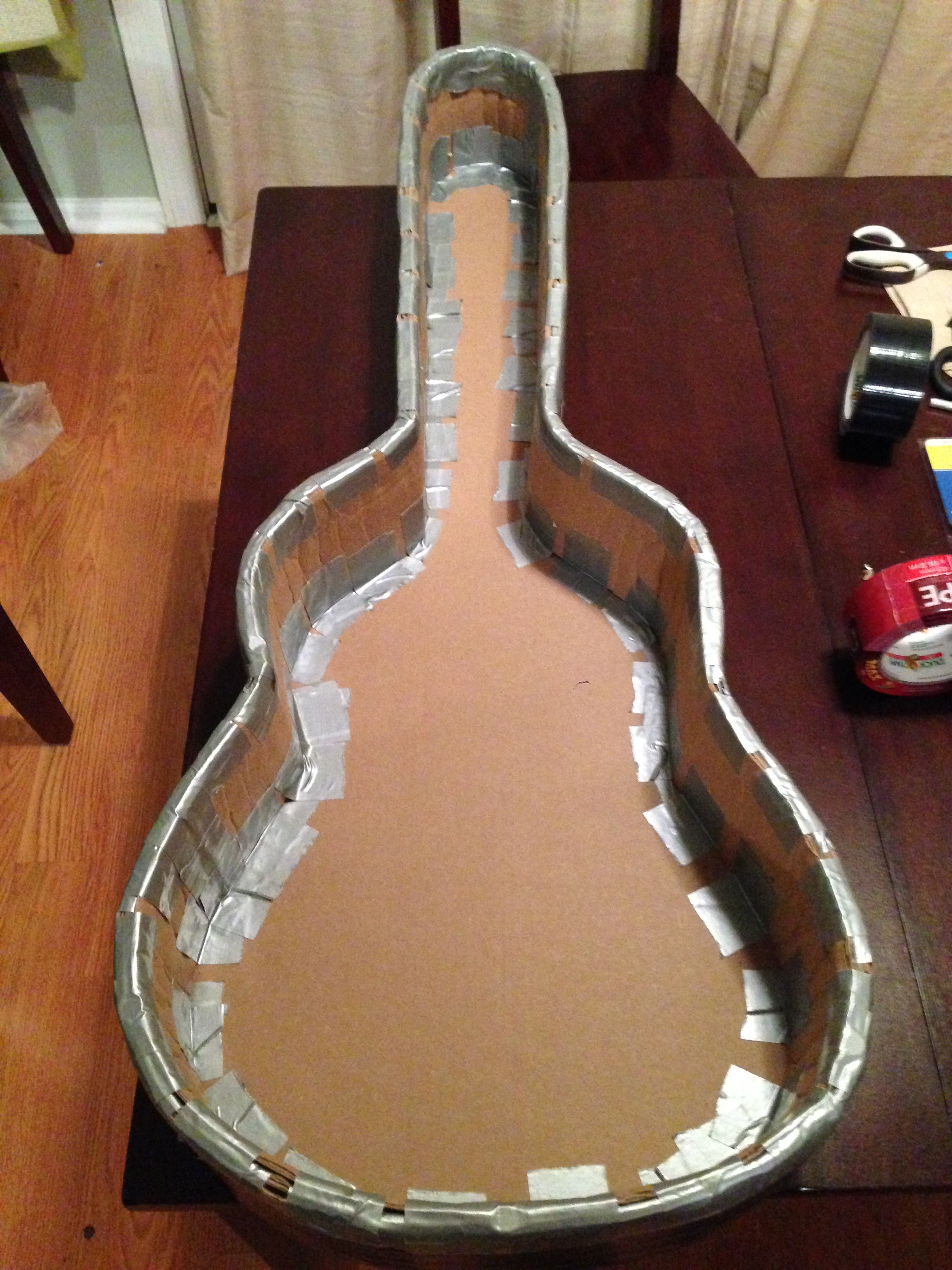
I split the cutout in half and duct taped two sets of four plies together to create a top and bottom for the case. I placed the guitar in between the cutouts and measured the thickness needed for a secure, yet comfortable fit. Five inches appeared to be reasonable, so I drew a 5” strip on the remaining cardboard from the cutout and cut it with a circular saw. I cut two additional bundles of strips.
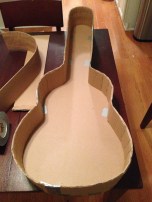
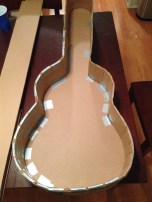
IMG_2665 IMG_2666 IMG_2667 IMG_2670 IMG_2672IMG_2676IMG_2677

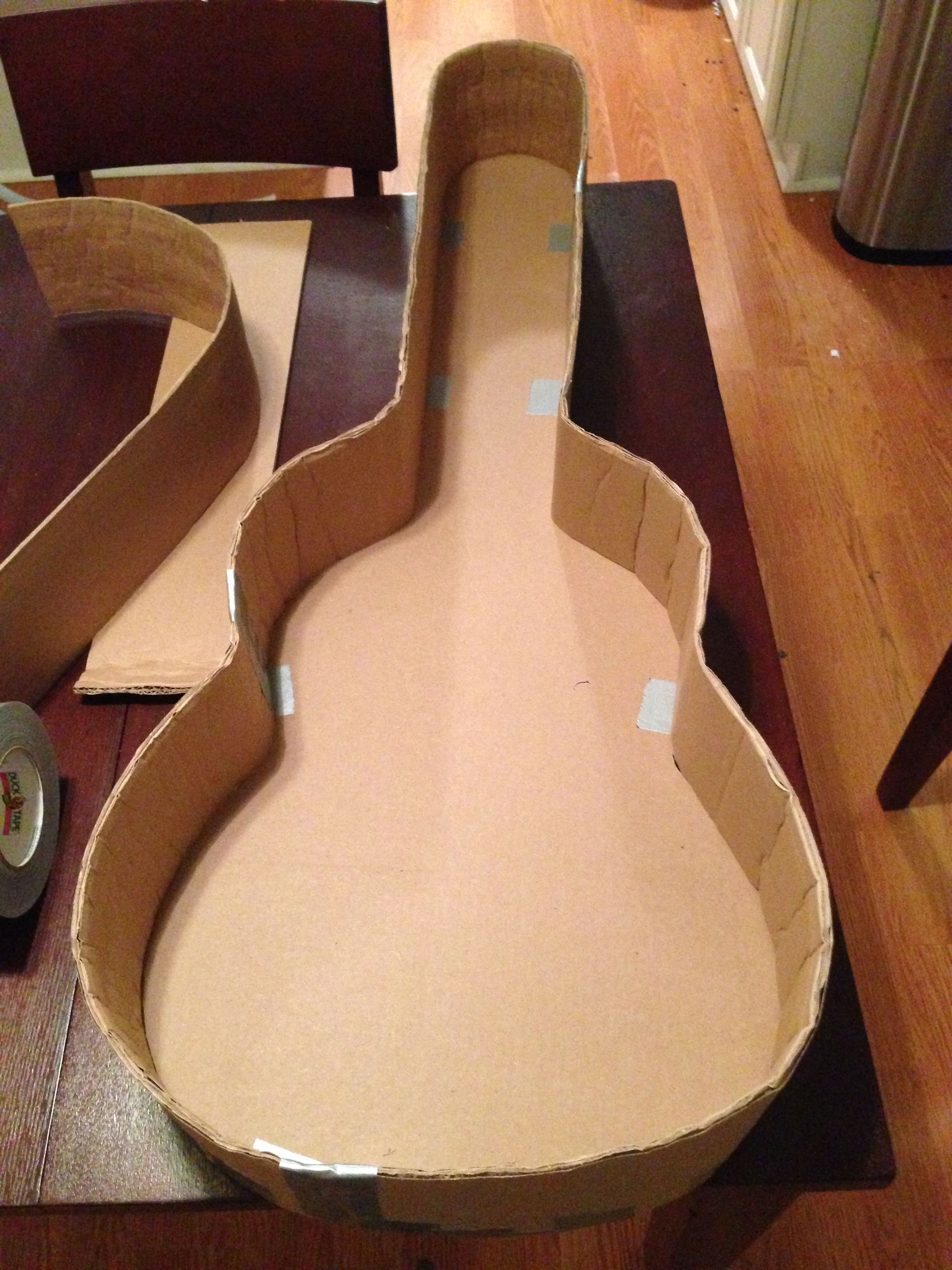
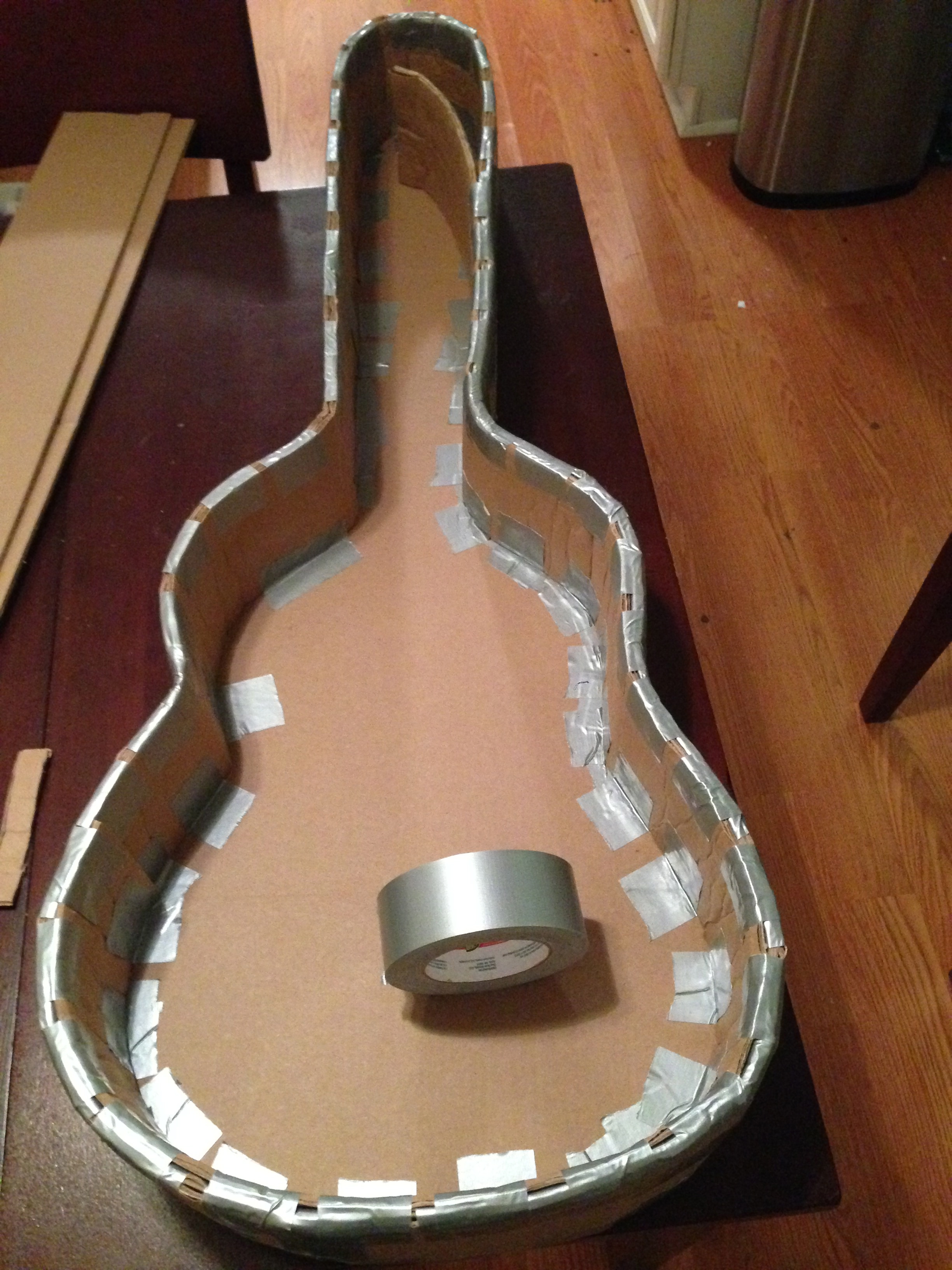
Using duct tape, I formed the outside shape for the side of the case. I added a second and then a third layer to the inside of the case—at this point it felt pretty solid. I spliced the ends together and then checked the fit of the guitar, along with confirming that the sides were deep enough by checking the lid. I reinforced the bottom and sides with gray duct tape and then began applying black duct tape to the bottom. I decided to create diagonal stripes with the tape and covered the bottom, pulling it tight as I secured the ends up the sides of the case.

IMG_2679 IMG_2680

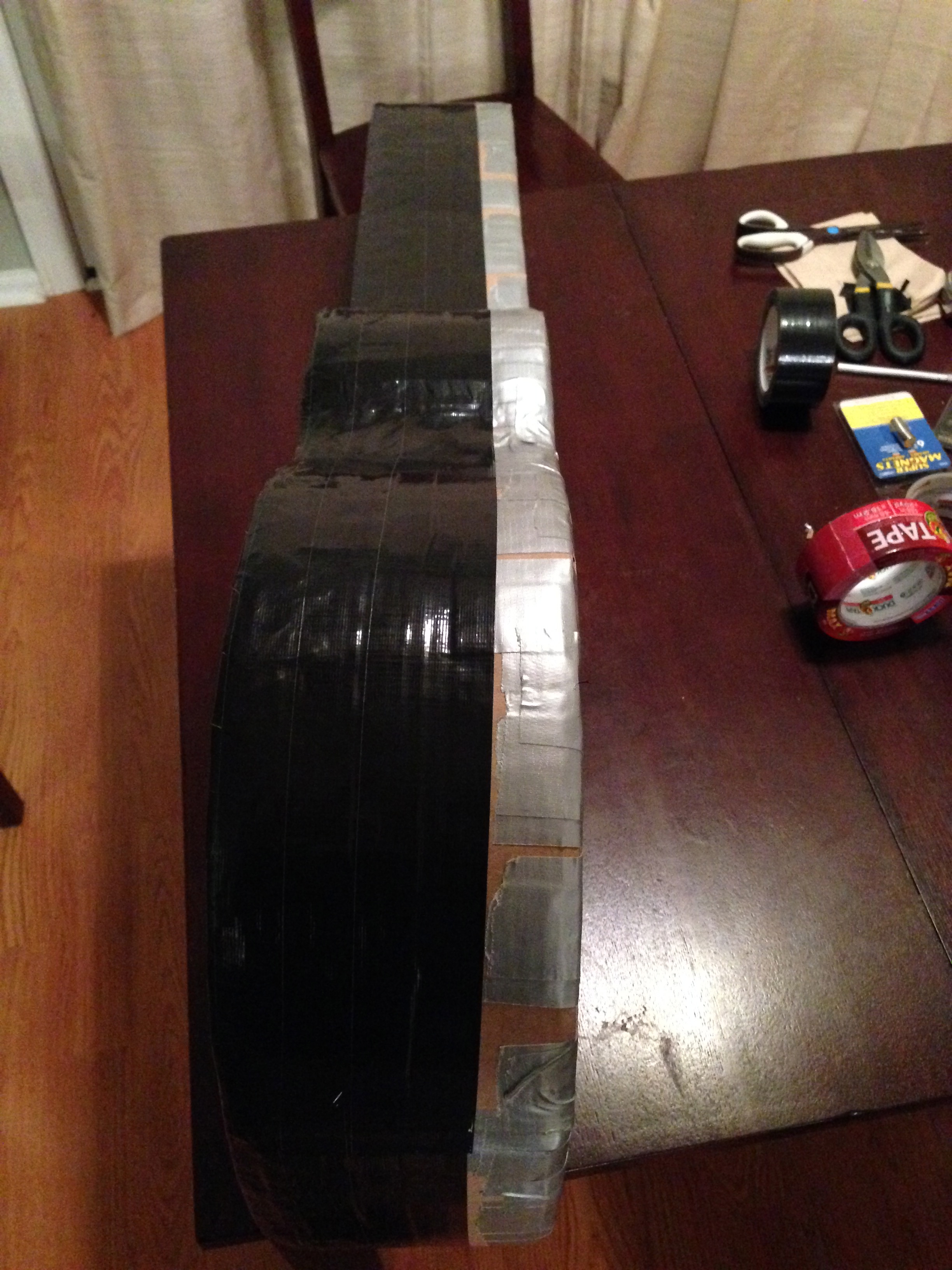
I applied tape to the sides of the case. Starting at the bottom of the case, I placed strips of black duct tape around the sides, progressing upward until there was about a 2” gap at the top. (I found that using duct tape meant that you had to plan out how the layers would be applied, so that each layer covered the messiness of the last layer. It would never be a perfectly flat finish, but the bumpiness would at least be covered.)
IMG_2681 IMG_2682

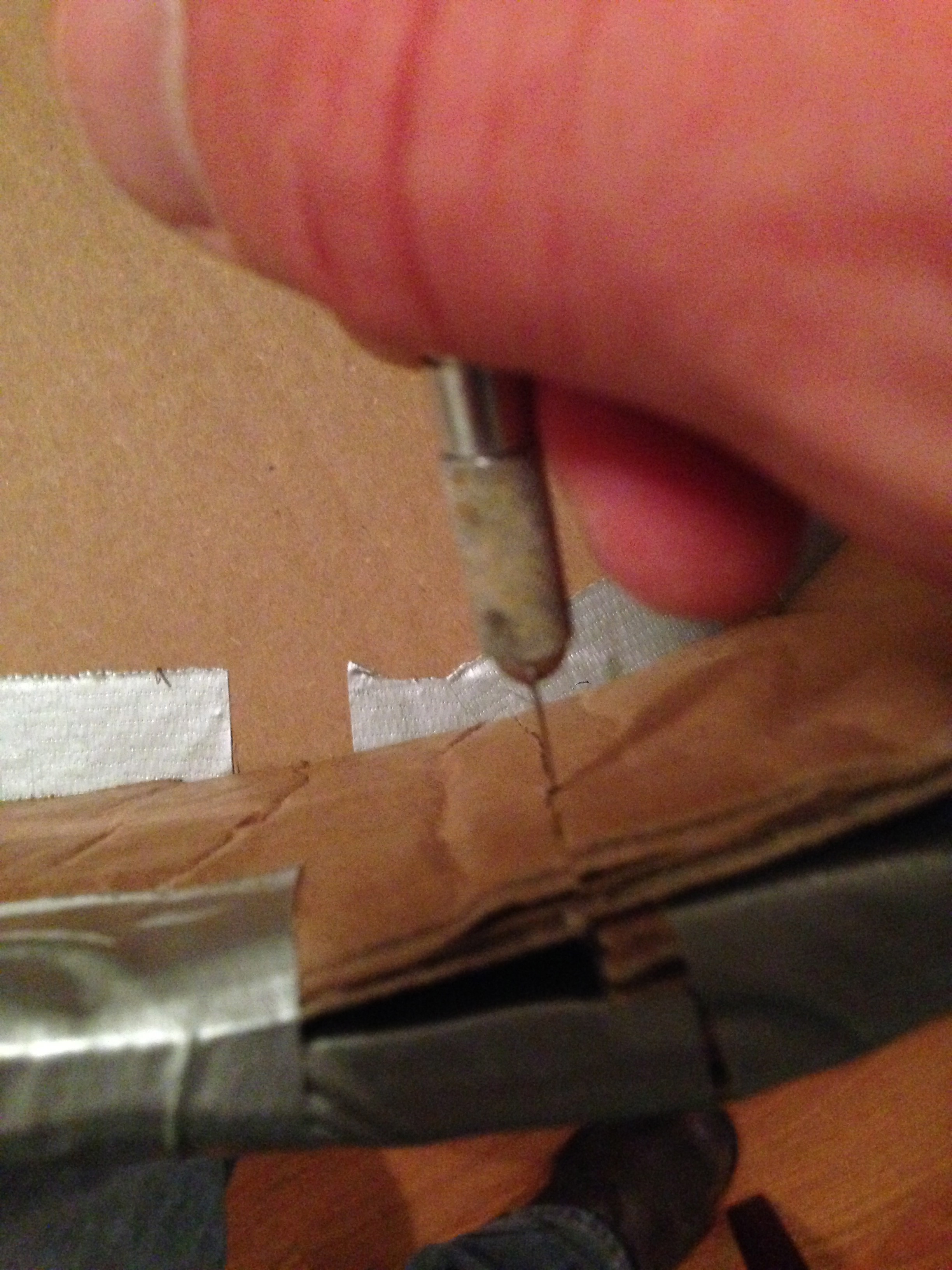
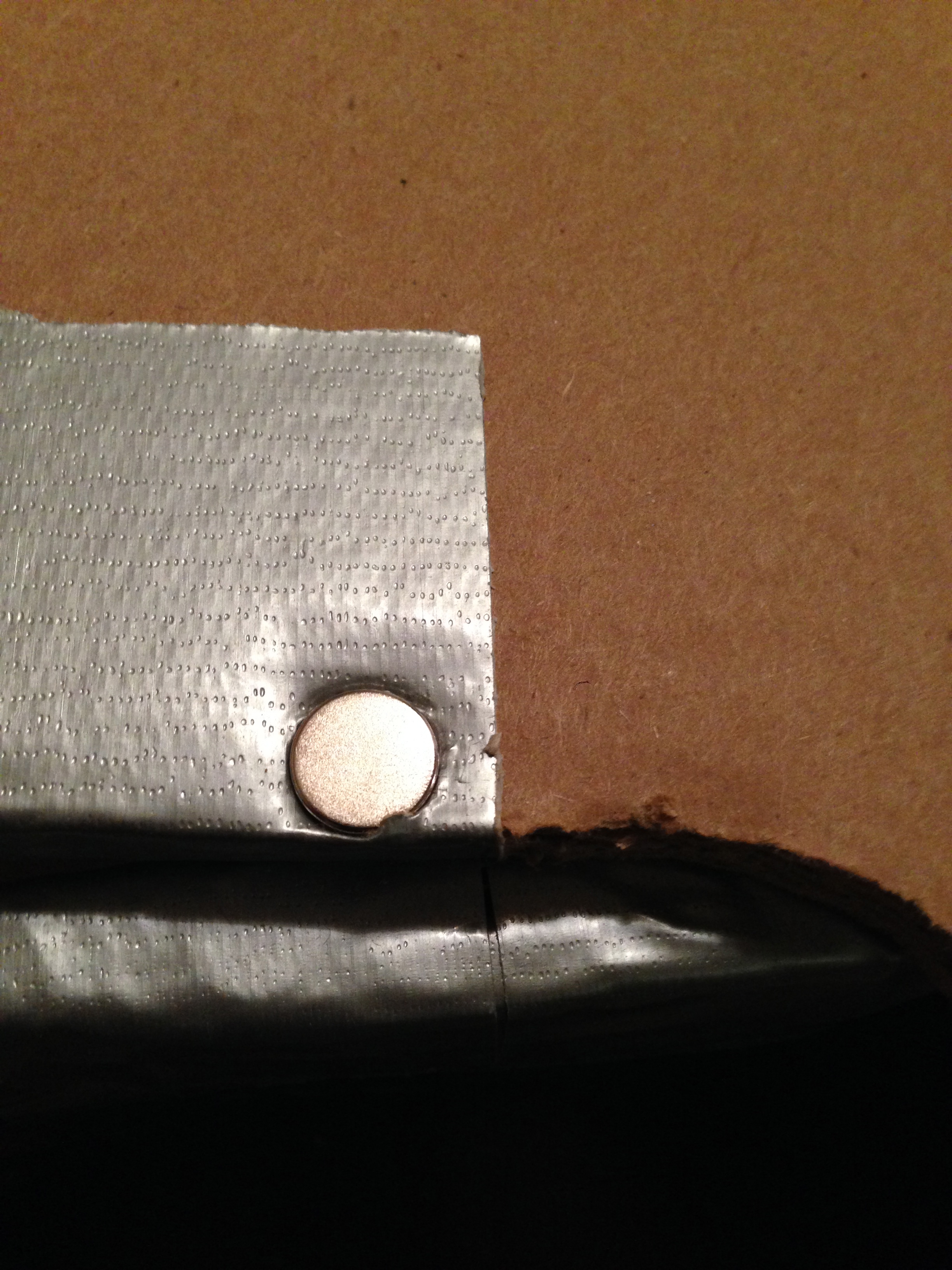
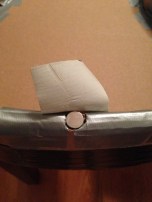
I prepared the lid and sides of the case for the magnets that would hold the lid on the case. I cut small holes in ten places around the rim on the sides of the case and then cut ten holes in similar locations on the bottom of the lid. I installed the magnets such that the sides would attract the lid, and then secured the magnets with duct tape and tested the lid.

IMG_2683 IMG_2684 IMG_2685

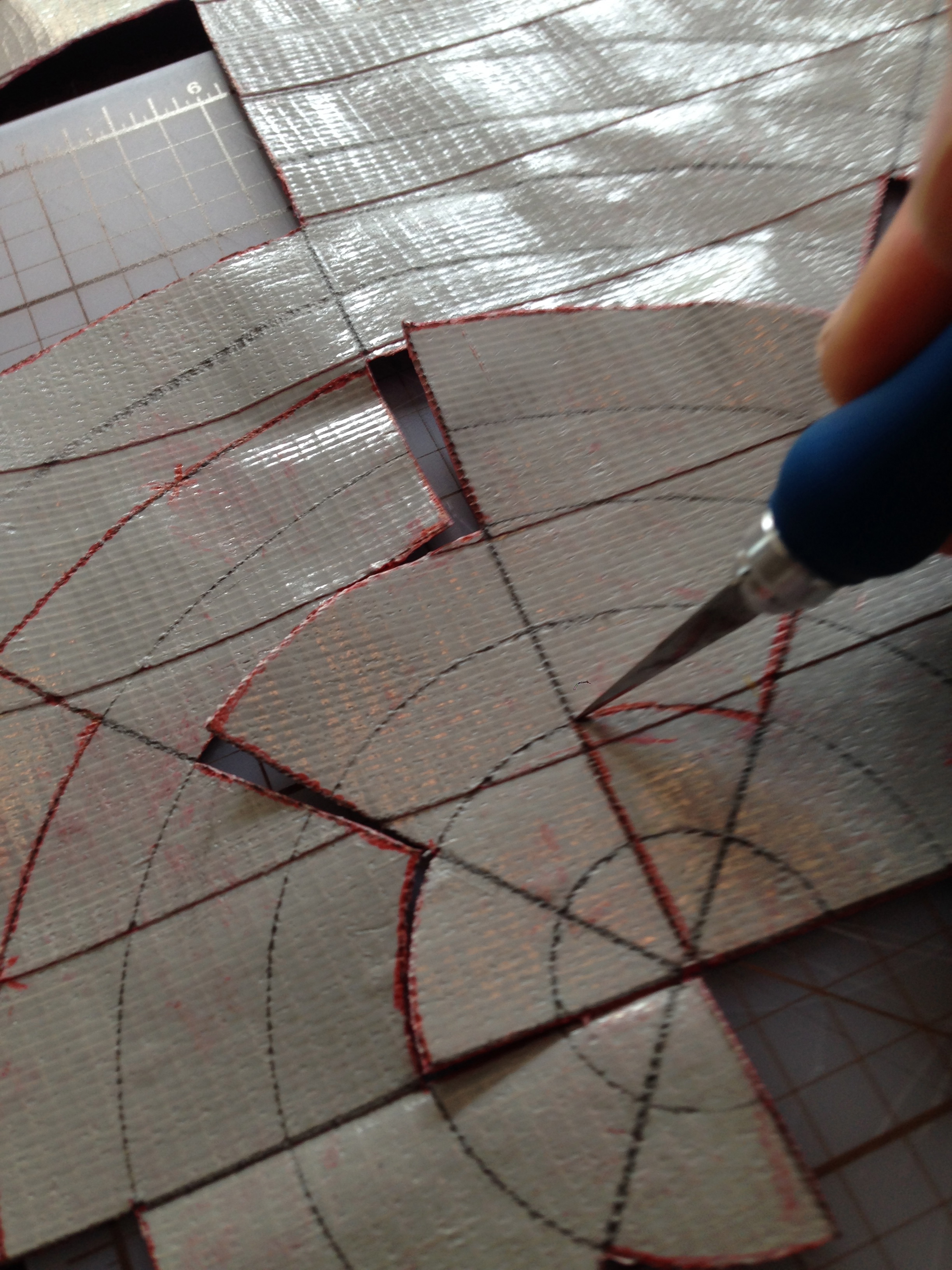
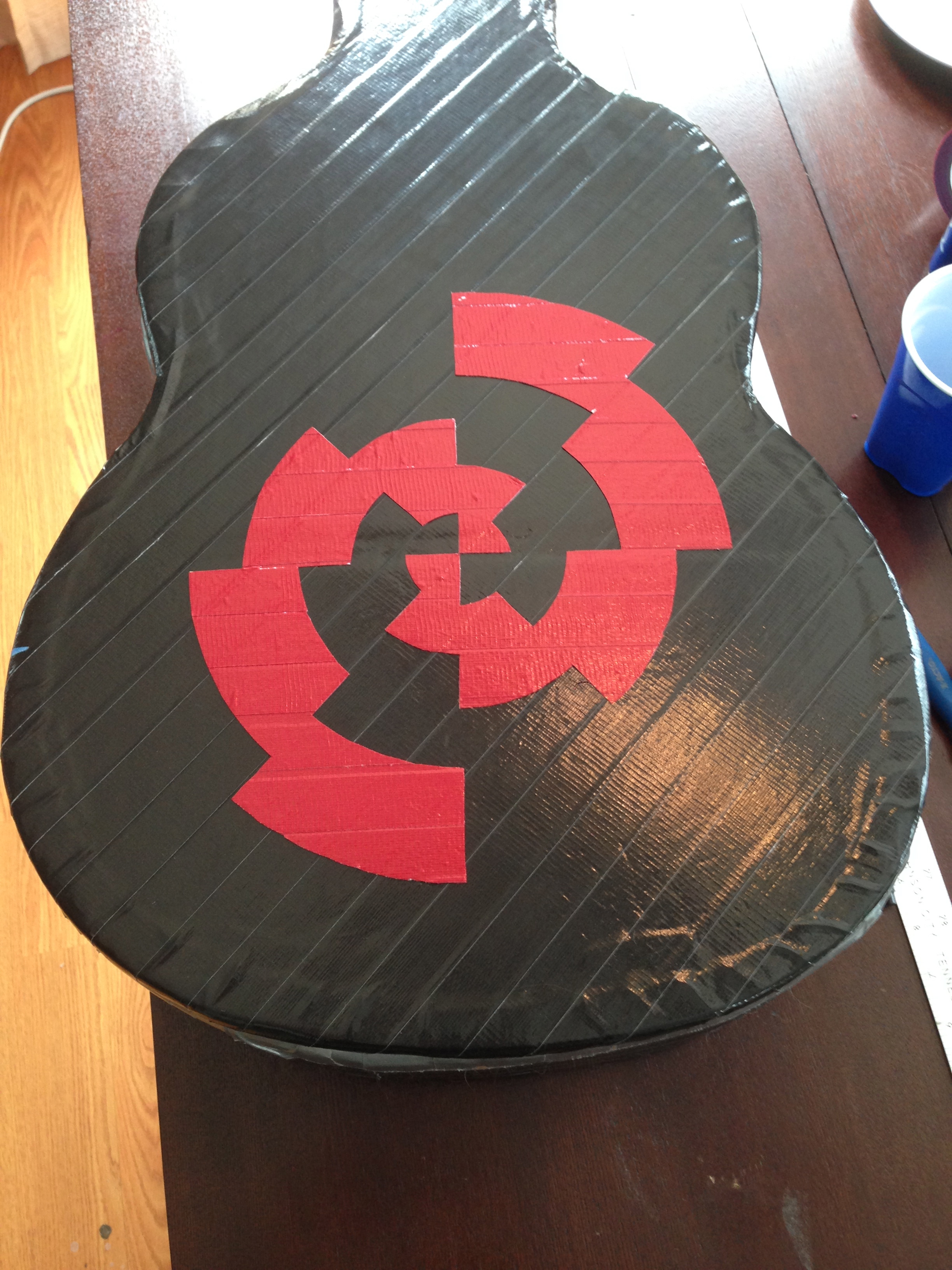
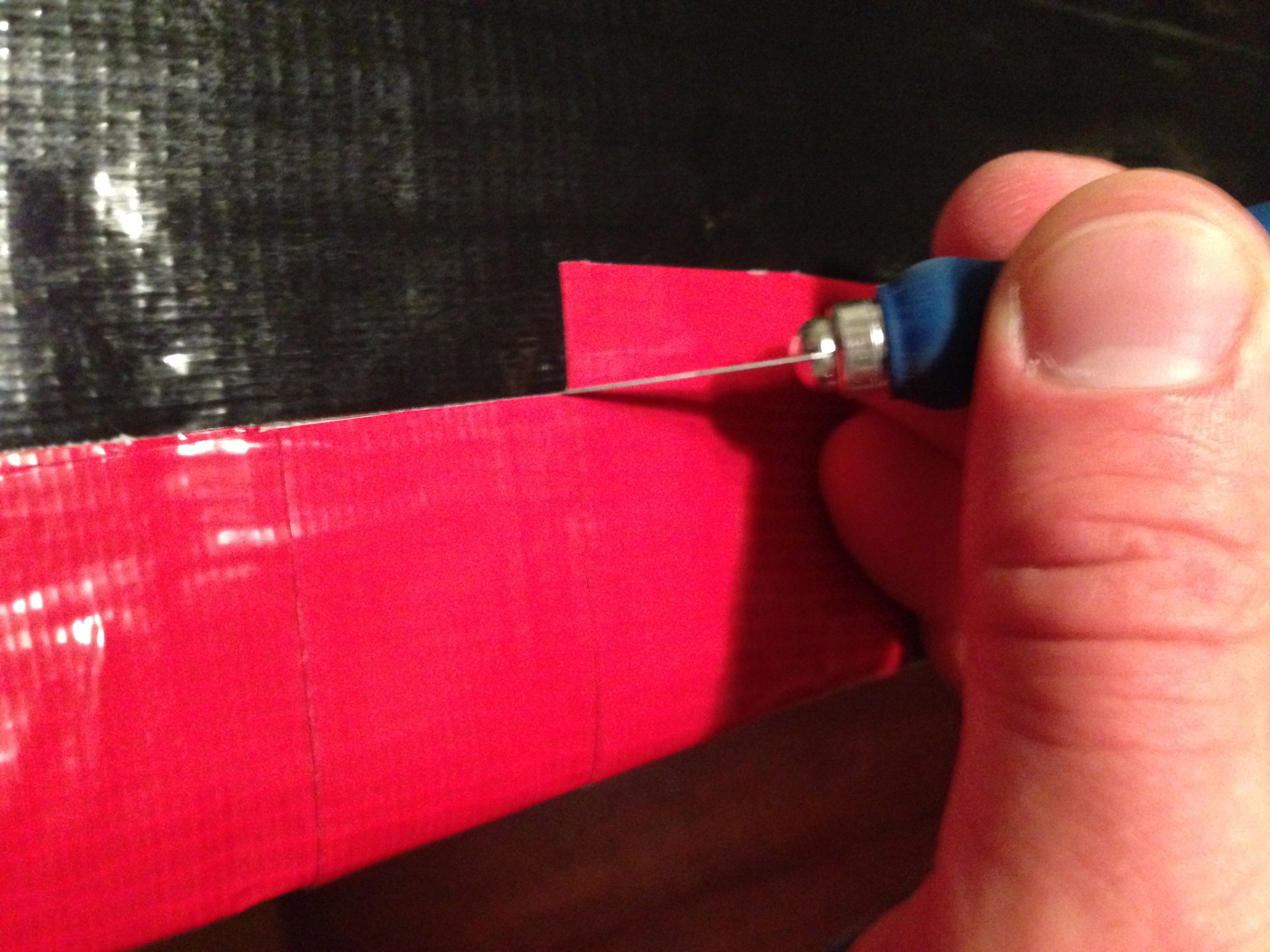
The spiral design is something I created a long time ago for a band that never came to fruition. I placed tight layers of red duct tape in steps (much like the back of the case) until I reached a desired length and width. Then, I sketched out the circular graph on the back of the tape with a ruler and compass. I drew the spiral backwards and then cut it out with an X-acto knife. It attached to the lid easily and turned out surprisingly well.

IMG_2686 IMG_2687 IMG_2688

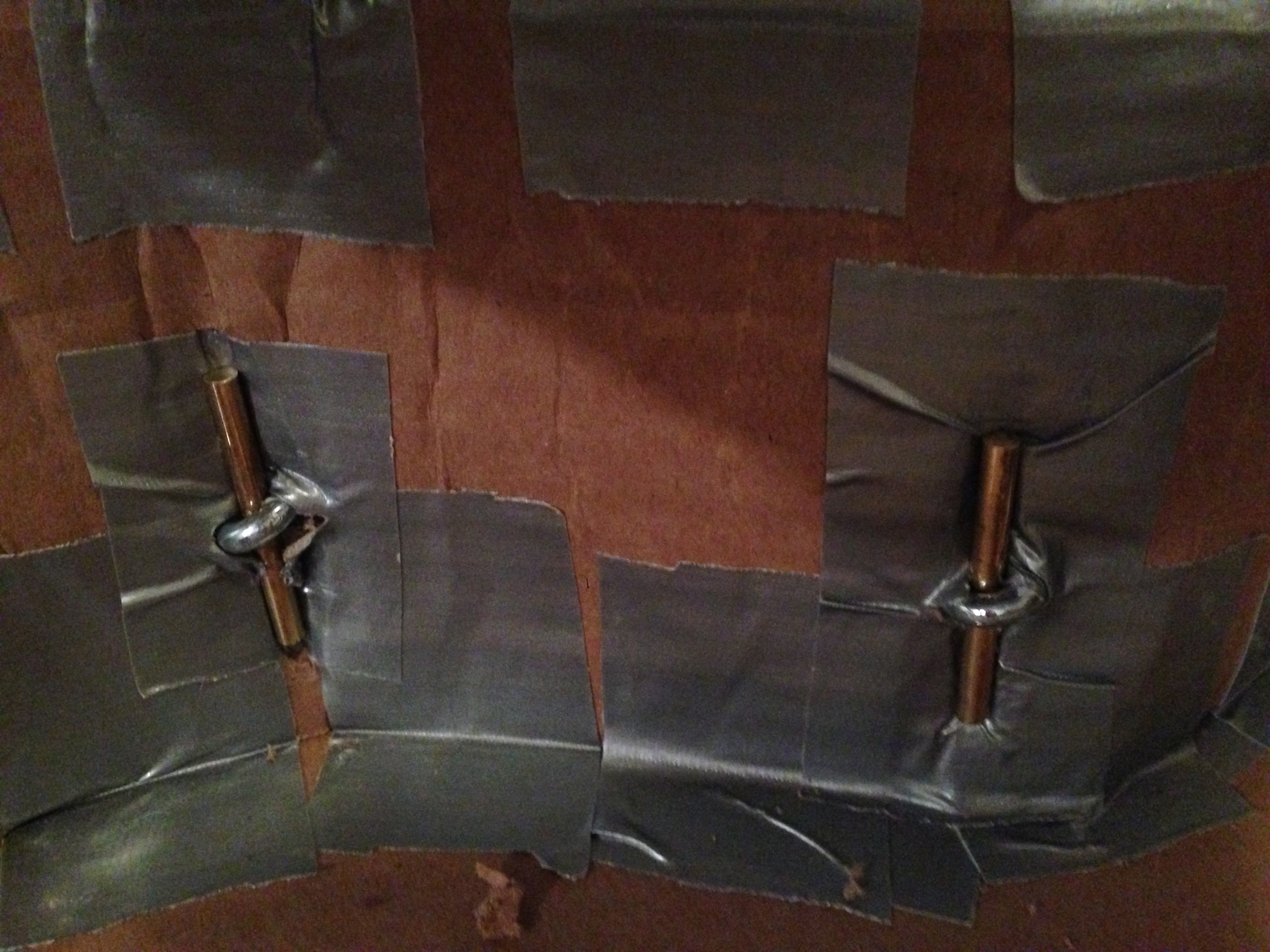
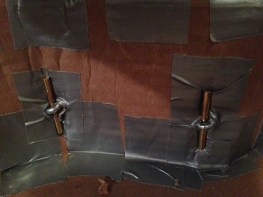
I was concerned about what to use for a handle for most of the project, but I couldn’t be happier with the chain handle that I ultimately decided on. It installed easily. Two cuts in the side of the case and some scrap brass bar to hold the ends securely in place. A couple pieces of gray duct tape finished the ends nicely.
IMG_2691 IMG_2692

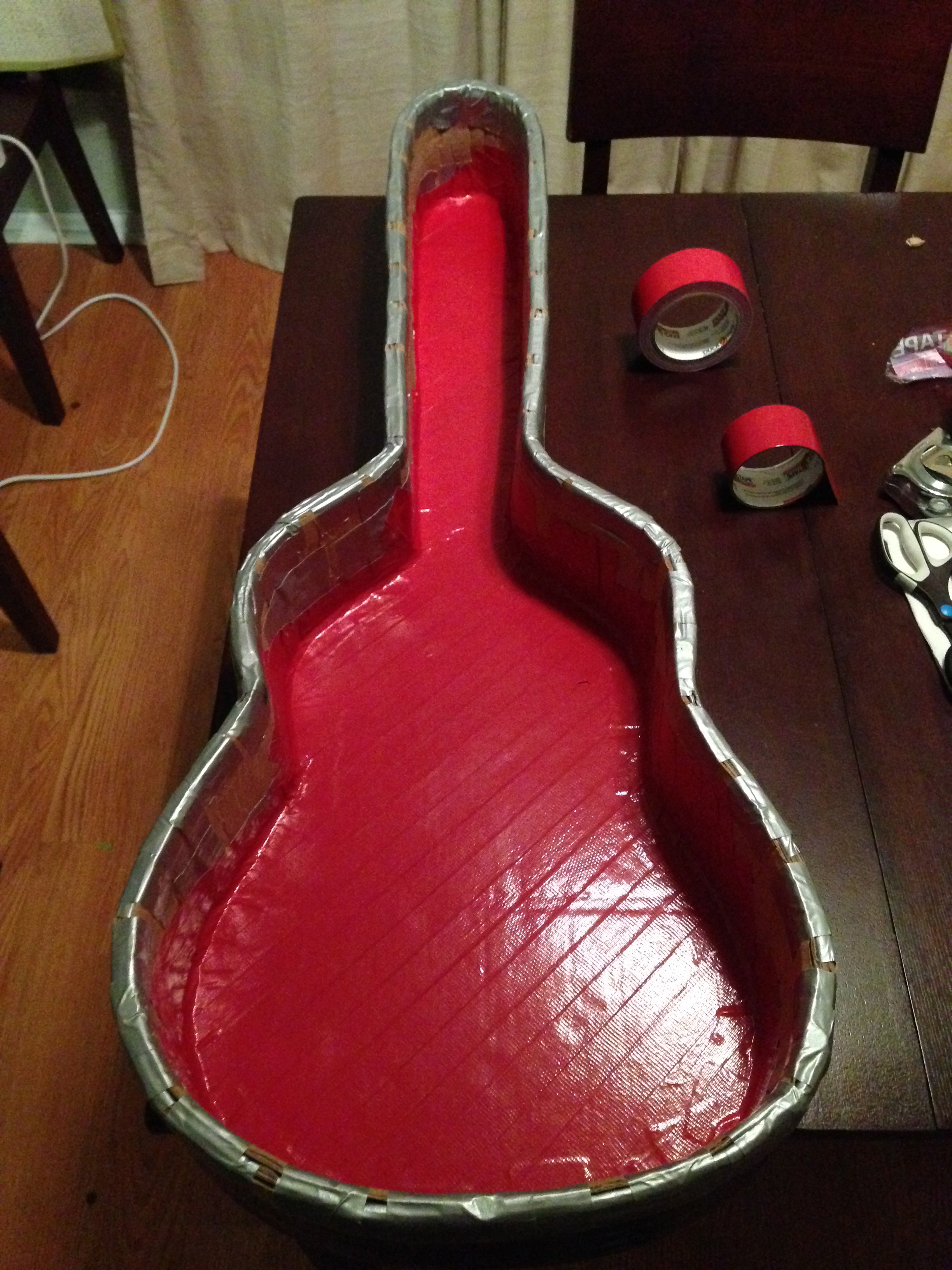
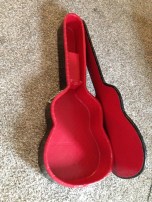
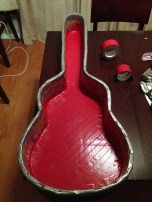
As for the remainder of the case, I added red duct tape to the bottom interior of the case in the same diagonal patterns as the outside. Next, I added vertical overlapping red duct tape around the interior sides, starting at the bottom side interior, up and over the rim, and onto the black tape around the exterior—the red duct tape was then cut flush with the black tape and the excess removed.

IMG_2701

To create the red stripe around the outside of the rim, I continued running the black duct tape in overlapping strips up the side of the case until there was a thin strip of red around the rim. I applied red duct tape on the bottom side of the lid—I cut the strips of tape long and cut it to shape so that there was a thin strip of black around the underside of the lid. Lastly, I used scrap cardboard and red duct tape to create a neck rest and storage compartment.

Building this case was a lot more work than I had anticipated, and ultimately cost slightly more that the used cases that I passed on because of price, but it was an awesome project just the same.

IMG_1926